.webp) 18+
18+
18+
18+
Free demo — no real money. Loads the provider's official demo build. Demos may be unavailable in some regions.
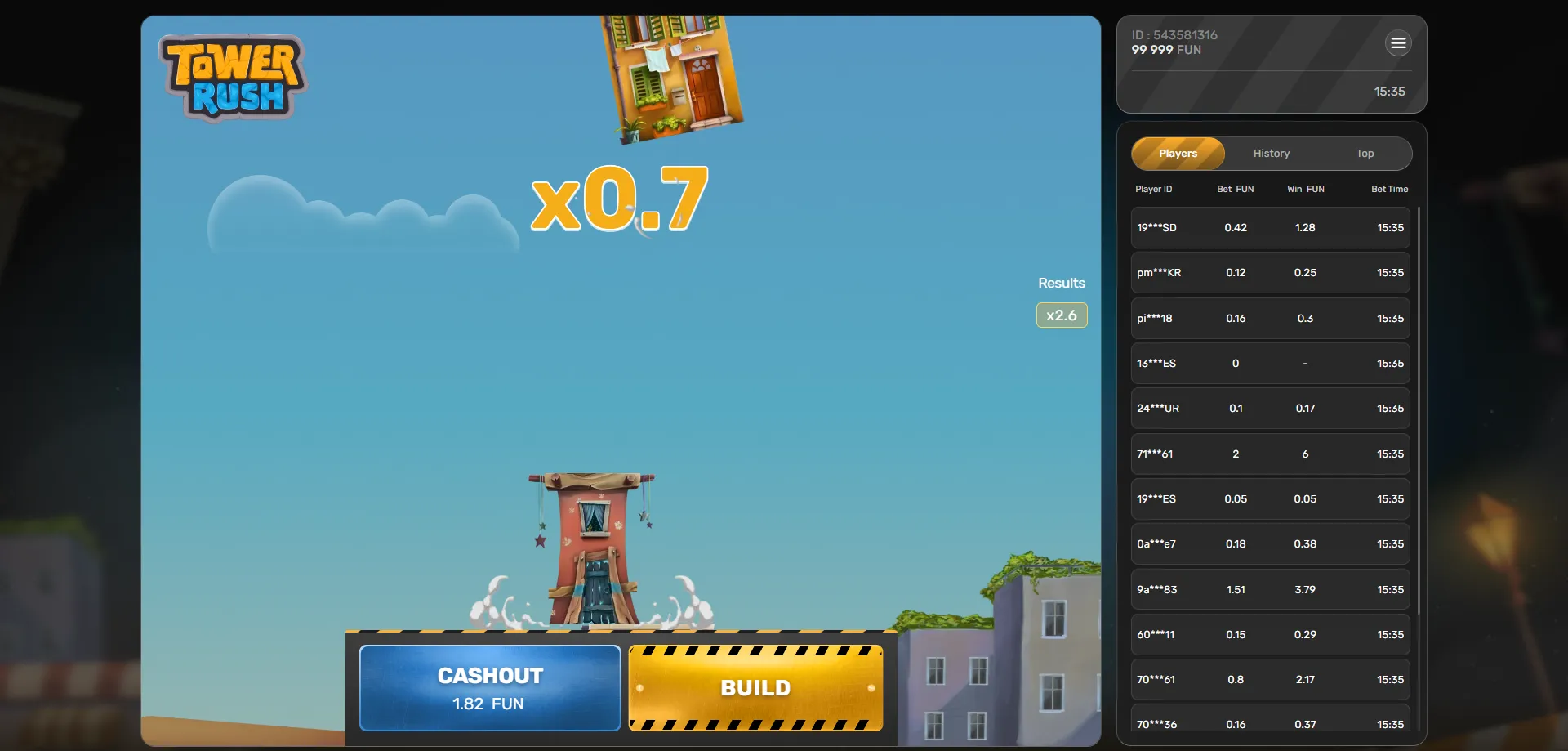
Tower Rush is a crash-format game developed by Galaxsys. Every round, a multiplier rises from 1× as a virtual tower builds upward, and your only decision is when to press the cash-out button before the structure collapses. The game uses a certified random number generator (RNG) and a provably fair cryptographic system, which means that each round's crash point is determined before bets are placed and cannot be influenced by the casino or the player after the round has started.
That fact matters before discussing any strategy. No method can predict when the tower will fall. What strategy can do is shape how you manage your money, how consistently you exit at chosen multipliers, and how you limit losses during inevitable downswings. The role of strategy in Tower Rush is risk management, not outcome manipulation. Understanding this distinction is the foundation of every useful tactic covered on this page.
The game's RTP sits at approximately 97%, which is competitive by casino standards. Over a long enough session, this figure implies a lower theoretical house edge than most slot games. However, high volatility means your personal results in any given session can deviate sharply from that long-run average — in both directions.
Tower Rush is classified as high volatility. In practical terms, this means rounds can end almost instantly at 1.01× just as often as they can climb to 20× or beyond. There is no streak protection or guaranteed pattern. A session can produce ten consecutive early crashes followed by several high multipliers — or the reverse. Any strategy that claims to guarantee wins by waiting for a pattern is misrepresenting how the RNG works.
The risk profile changes significantly depending on your cash-out target. Players aiming for low multipliers — between 1.5× and 2× — will cash out successfully more often, but each win is small relative to the stake. Players targeting multipliers above 5× or 10× will win less frequently but receive larger payouts when they do succeed. Neither approach is inherently superior; the right choice depends on your bankroll size, session goals, and emotional tolerance for consecutive small losses.
High volatility also means that protecting your session budget from rapid depletion is a genuine technical challenge. A player who stakes too large a proportion of their budget on each round can be eliminated from a session within a handful of early crashes, even if the longer-run odds would have eventually moved in their favour. This is why bankroll structure is discussed separately as its own section below.
Observing how different players approach Tower Rush reveals three broad styles, each with a distinct risk-reward trade-off:
Most players instinctively drift between styles mid-session, particularly after a win or a loss. Recognising which style you are currently playing — and choosing it deliberately rather than reactively — is itself a meaningful strategic habit.
If you are new to Tower Rush, the most practical starting framework combines two elements: a fixed cash-out multiplier and a per-round stake limit.
Choose a target multiplier before each session and commit to it for the duration of that session. A value between 1.5× and 2× is a reasonable starting point. Set this as an auto cash-out within the game's settings — this removes the temptation to wait just a little longer and eliminates impulsive manual exits at lower values.
Limit each round's stake to no more than 2%–3% of your total session budget. If you begin a session with ₹1,000, each round should cost no more than ₹20–₹30. This gives you enough rounds to absorb losing streaks without exhausting your budget before the session has had a chance to develop. At a 1.5× cash-out target, a single successful round at ₹20 stake returns ₹30 — a ₹10 net gain. The model is slow but structured.
These two rules — fixed multiplier target and capped per-round stake — form the core of almost every more advanced strategy. Variations primarily adjust these two numbers based on risk appetite and available budget.
Cash-out timing is the central skill in Tower Rush. There is no statistically correct moment that applies universally — the crash point is random every round. What you can control is the consistency of your exit decision.
The most reliable approach is pre-committing to a target before the round begins. Using the auto cash-out feature, set your target multiplier for the session and allow it to execute automatically. This prevents two common errors: cashing out too early in a panic when the multiplier slows, and holding too long in the hope of a bigger number.
Manual cash-out is also used by players who prefer flexibility, particularly those responding to bonus floor triggers such as the Frozen Floor mechanic, which provides a temporary safety net during certain rounds. If a bonus floor activates, experienced players often adjust their cash-out target upward for that round, since the floor provides temporary protection against the crash. However, over-relying on bonus floors as a timing signal is risky — they are RNG-triggered and cannot be predicted in advance.
One useful rule for manual players: decide your exit point before the round starts and write it down or set it mentally as a firm target. Adjust only if a bonus floor activates. Do not revise upward simply because the multiplier is rising — every active round is one instant away from collapse regardless of how far it has already climbed.
Bankroll management is arguably the single most impactful variable under a player's direct control. In a high-volatility crash game, the size of your individual round bets relative to your total session budget determines how long you remain in the game — and therefore how many rounds you have for variance to even out.
A conservative framework allocates 1%–2% of the session budget per round. A moderate framework allows up to 3%–5%. Anything above 5% per round accelerates the risk of session-ending losses from a short run of early crashes. With Tower Rush's high volatility, a five-round losing streak is not unusual — it is an expected event over any meaningful number of sessions.
Practical steps for session budgeting:
Indian players using UPI, Paytm, or other local payment methods at INR-compatible casinos should note that minimum stakes at most platforms start at ₹10–₹50 per round, making it possible to play full structured sessions even on modest budgets.
Keeping a simple record of your Tower Rush sessions provides data that no strategy article can give you — information about your own tendencies. A basic session log should capture: the date, your starting and ending balance, your cash-out target for the session, how many rounds you played, and any deviations from your planned target (early exits, late holds).
Over several sessions, patterns emerge. You may find that you consistently exit earlier than your stated target under pressure — a sign to lower the target to one you can realistically commit to. You may find that sessions where you stuck to auto cash-out produced more consistent results than sessions where you switched to manual mid-way. This kind of evidence, drawn from your own play, is more actionable than any generic tip.
Tower Rush's provably fair system also allows you to verify individual round outcomes after a session using the cryptographic seeds provided by Galaxsys. This is not a strategy tool but a transparency mechanism — it confirms that the outcomes you experienced were genuinely random and not manipulated by the platform.
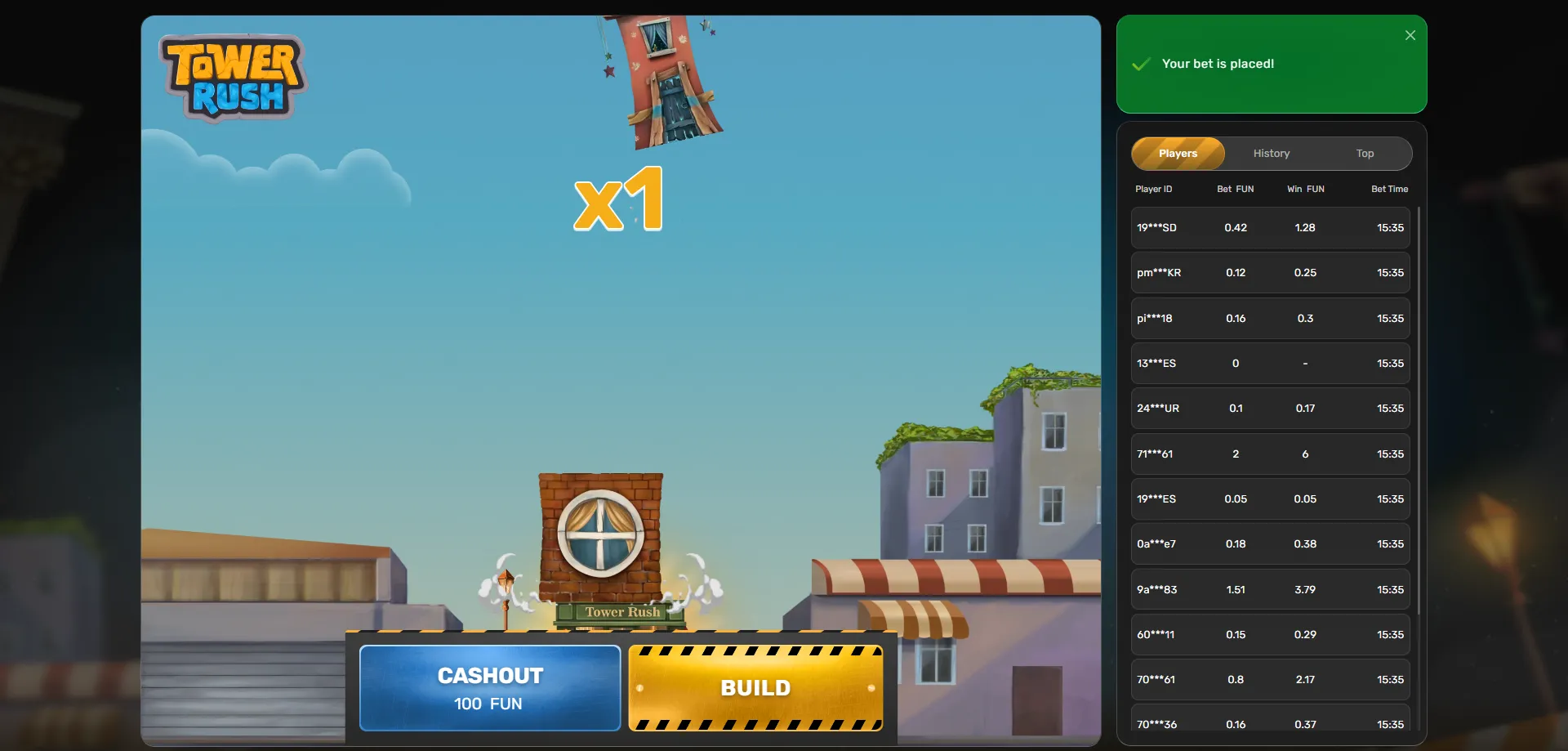
The Tower Rush demo is available at a range of online casinos and replicates the full real-money experience using virtual credits. Playing in demo mode is not just a way to learn the interface — it is a legitimate strategy development tool when used deliberately.
In demo mode, test your planned cash-out targets across at least 50 rounds before committing real money. Observe how often your target multiplier is reached before the crash. Count how many consecutive early crashes occur. This gives you a realistic calibration of variance at your chosen risk level, rather than discovering it for the first time with a live balance.
Demo mode also allows you to test whether auto cash-out behaves as expected at your chosen value. Some players discover in demo that their planned target is reached far less often than their intuition suggested — and adjust their strategy accordingly before any real funds are at risk. Treat the demo as a training environment rather than a casual warm-up, and it adds genuine value to your approach.
Tower Rush rounds complete in seconds. This speed creates a specific psychological pressure that longer-format games do not. In a traditional slot, each spin takes a few seconds and there is natural pause time. In Tower Rush, the window between rounds is brief and the temptation to place the next bet immediately — especially after a loss — is significant.
The most common emotional pattern in crash games is loss chasing: after an early crash, increasing the next stake to recover the loss faster. This directly undermines bankroll management and accelerates the depletion of a session budget. A disciplined player keeps the stake constant regardless of the previous round's result.
A second pattern is premature exit: cashing out well below your planned target after several successful rounds, driven by anxiety about giving back gains. While protecting profit has merit, doing it inconsistently below your stated target means your actual results never reflect your intended strategy — making it impossible to evaluate whether the strategy works.
Setting auto cash-out handles both problems mechanically. When the game executes the exit on your behalf, human hesitation and reactive adjustment are removed from the equation. For players who find emotional control difficult during live play, auto cash-out is not a convenience — it is a core component of any sensible strategy.
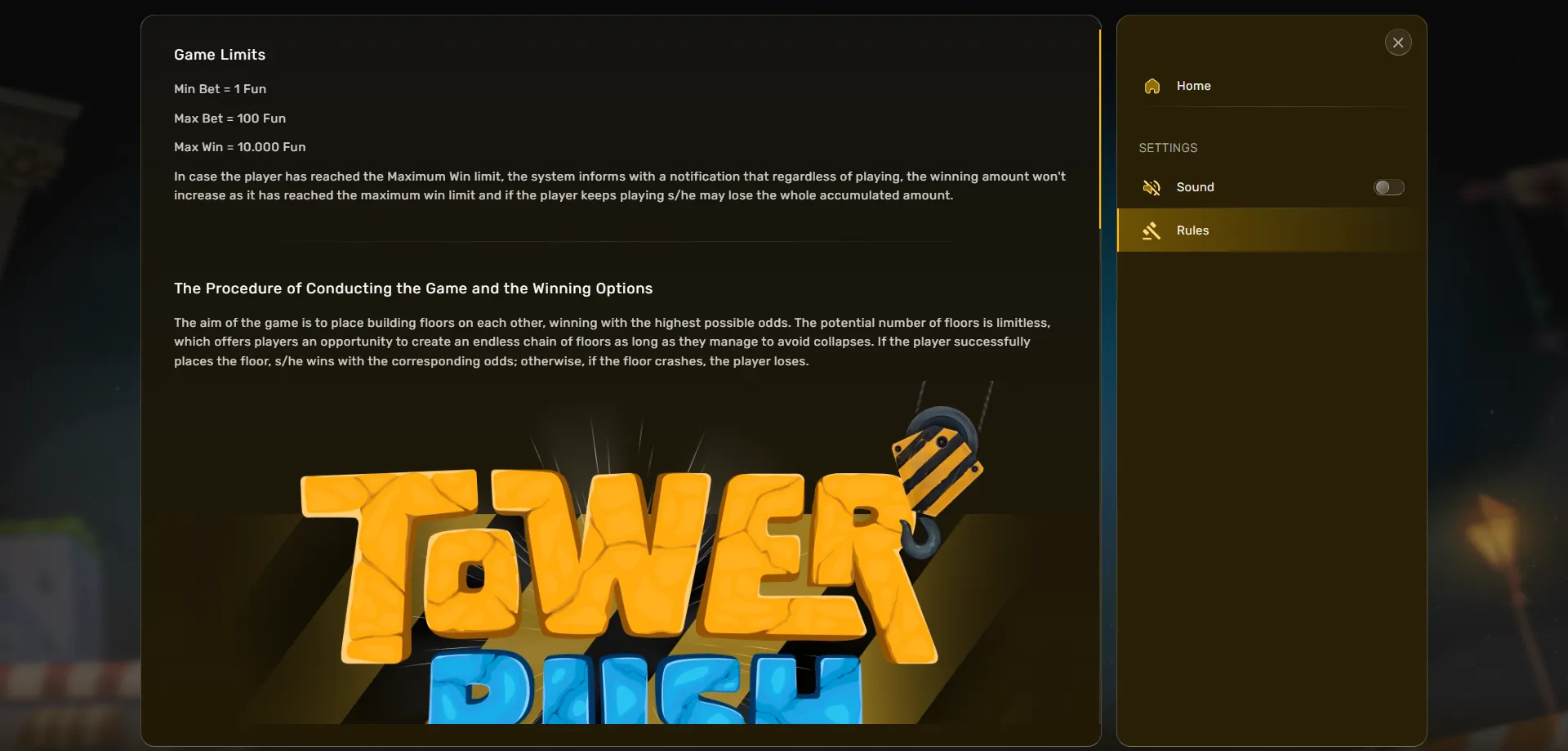
Searching for tower rush game tricks will surface a range of claims — pattern recognition systems, timing formulas, and history-based prediction methods. It is worth being direct about these: no trick can alter the outcome of a round that is determined by an RNG before bets are placed.
What genuinely function as useful techniques are the following:
The tricks that do not work include: waiting for a sequence of early crashes before betting large (each round is independent); using progressive staking systems like Martingale to guarantee recovery (these accelerate losses in high-volatility environments); and observing other players' results as predictive data (their outcomes have no relationship to your upcoming round).
Over a large enough number of rounds, a disciplined Tower Rush player who adheres to bankroll rules and consistent cash-out targets will experience results that more closely reflect the game's ~97% RTP than a player making impulsive decisions each round. This is not because strategy changes the odds — it does not. It is because consistent strategy removes the behavioural deviations that typically push real-world results below the theoretical return.
The player who bets 20% of their budget on a single round and crashes out immediately, then doubles the next stake to recover, will almost always produce worse results than the game's RTP would predict. The player who bets 2%, takes the same losses at the same crash points, but spreads them across a much larger number of rounds, gives variance more opportunity to distribute. Strategy does not reduce the house edge — it prevents self-inflicted damage on top of it.
For more context on the game's statistical profile, visit the Tower Rush RTP and Volatility page, which covers how the 97% figure is calculated and what it means for different session lengths. If you are still learning the mechanics, the How to Play Tower Rush – Game Guide covers the full gameplay flow from bet placement to cash-out confirmation.
Tower Rush is a provably fair, high-volatility crash game with an approximately 97% RTP. No strategy can predict or influence its RNG-determined outcomes. What strategy does is structure your behaviour around those outcomes — protecting your session budget from rapid depletion, keeping your cash-out decisions consistent, and giving you the emotional tools to play within a framework rather than reactively.
The most effective approach combines a pre-set auto cash-out multiplier, per-round stakes capped at 1%–3% of your session budget, a hard stop-loss limit, and demo mode practice before committing real funds. Players who apply these principles consistently will not win every session — but they will give themselves the best realistic chance of managing variance in a game designed to be fast, transparent, and unforgiving of impulsive decisions.
Sign up today to receive an exclusive multiplier boost on your first deposit and start scaling the Tower Rush leaderboards.
🎯 Play Tower Rush🔒 18+ · T&C Apply · Play Responsibly